Phoenix Water Damage Restoration in Ontario: A Homeowner’s Guide
Phoenix Water Damage Restoration is one of the restoration companies operating in the Ontario, CA market, but the name on the van tells you almost nothing about what happens inside your home after a pipe bursts or a supply line fails. What actually determines whether your drywall gets saved or demolished is the equipment inventory the company runs, the certifications the technicians hold, and whether their drying methodology aligns with IICRC standards. If you’d rather skip the research and talk to someone directly, call (833) 589-8366 for a free estimate.
Two Companies, Same Hour, Different Outcomes
Here’s the scenario we see play out in Ontario constantly. A homeowner calls two restoration companies. Both answer the phone quickly. Both show up within the hour. Both set down air movers and dehumidifiers, and both hand over an authorization form to sign. Then one company dries the house in four days with zero mold follow-up, while the other drags through nine days, tears out baseboards that could have been saved, and the homeowner fights secondary damage for months.
The difference isn’t effort. It’s equipment class. A conventional refrigerant dehumidifier in a portable rental unit will pull moisture until the air hits about 40% relative humidity, then it flatlines. An LGR (low grain refrigerant) dehumidifier keeps pulling water vapor below 40% RH, down into the high 20s and low 30s, which is where structural materials actually release trapped moisture. In Ontario’s dry summer climate, a homeowner might think things are drying fine because the air feels dry, but drywall and framing wood hold moisture long after the air passing over them feels arid to a hand.
This is why we run Dri-Eaz and Phoenix LGR units rather than rental-store equipment. The grain depression capacity of the dehumidifier determines whether your studs dry or just your carpet. That’s also why a Dorchester Water Damage home inspection starts with moisture mapping, not a quick look around and a fan placement guess.
What Certifications Should You Actually Verify Before Signing?
Ask any Ontario restoration company what certifications their on-site technicians hold. If the answer is vague, that’s your answer. The specific IICRC certifications that matter for water damage work are WRT (Water Damage Restoration Technician), ASD (Applied Structural Drying), and AMRT (Applied Microbial Remediation Technician). WRT covers the science of water damage and the categories of contamination. ASD is the advanced drying science credential, the one that separates someone who places fans from someone who designs a drying system based on psychrometric calculations. AMRT matters if any mold is present or likely to develop.
Here’s the part most homeowners miss: you can verify these credentials on the IICRC registry website. Don’t just read the business card. A company can claim “IICRC certified” because one owner took a class a decade ago, but the tech walking into your kitchen at 2 a.m. might have no credential at all. In Ontario, where newer tract housing shares walls and floor assemblies, a technician who doesn’t understand structural drying can leave moisture trapped in shared wall cavities, and you won’t know it until the smell starts.
We align our entire process with IICRC standards, from initial moisture assessment through daily monitoring and final documentation. That alignment is what insurers and adjusters look for when they review a claim. It’s not a sticker; it’s a methodology backed by written standards.
Questions to Ask About the Drying Equipment Before Work Begins
Once a restoration company is standing in your living room, you have about ten minutes of leverage before they want a signature. Use it. Here’s what to ask:
- “What’s the grain depression capacity of the dehumidifiers you’re bringing?” If they can’t answer, they’re running consumer-grade machines. LGR units operate below 40 grains per pound at AHAM conditions. Conventional units don’t get close.
- “What airflow ratings are your air movers?” A proper structural drying setup uses multiple air movers per affected room, each moving hundreds of CFM. One fan per room is surface drying, not structural drying.
- “Do you have Injectidry or equivalent wall-cavity drying capability?” This is the question that separates structural drying companies from surface drying companies. If the answer is no, expect them to default to demolition when moisture is trapped in wall cavities or under sub-floors.
- “Will you document daily moisture readings?” If the answer is no or evasive, walk away. Daily moisture logs with relative humidity and moisture content readings are baseline documentation your insurer will eventually ask for.
In Ontario, where many homes sit on slab foundations, sub-floor moisture from a supply line leak can go unnoticed for days. We use Injectidry systems to pull moisture from behind baseboards and under flooring without cutting out drywall that can be saved. The alternative is demolition, and demolition is always more expensive than drying.
How to Evaluate a Scope of Work for Completeness
For any water damage above Category 1 (clean water from a supply line), a complete restoration proposal should include more than “extract water, set equipment, monitor.” Here are the line items that should always appear in a properly written scope for Category 2 or Category 3 water in Ontario:
- Containment and engineering controls – plastic barriers, negative air pressure where needed, sealing off unaffected areas
- Antimicrobial application – any water that sat for hours or contains contaminants requires treatment, not just drying
- Moisture content baseline readings – documented readings from affected and unaffected materials before equipment placement
- Equipment count by type – number of air movers, LGRs, and any specialty equipment like Injectidry panels, with a placement diagram
- Daily monitoring schedule – statement that readings will be taken daily, with adjustment of equipment as readings change
- Demolition-inclusive or demolition-avoidance approach – explicit statement about what gets removed vs. what gets dried in place
- Final clearance documentation – written statement that drying goals were met and no secondary damage is active
If any of those items are missing, the proposal is incomplete, and an insurance adjuster in Ontario reviewing your claim will notice the gaps. We document everything photographically from day one because we know the adjuster’s review is coming. That’s the difference between a restoration company that works with insurers and one that hopes nobody looks too closely.
Why the First 24 Hours of Equipment Placement Matter More Than Anything Else
Moisture that sits in building materials for more than 24 to 48 hours starts doing permanent damage. Mold spores, which are present in every Ontario home, begin colonizing wet drywall and wood quickly, especially in summer when indoor temperatures stay warm. The first equipment placement either stops that clock or doesn’t.
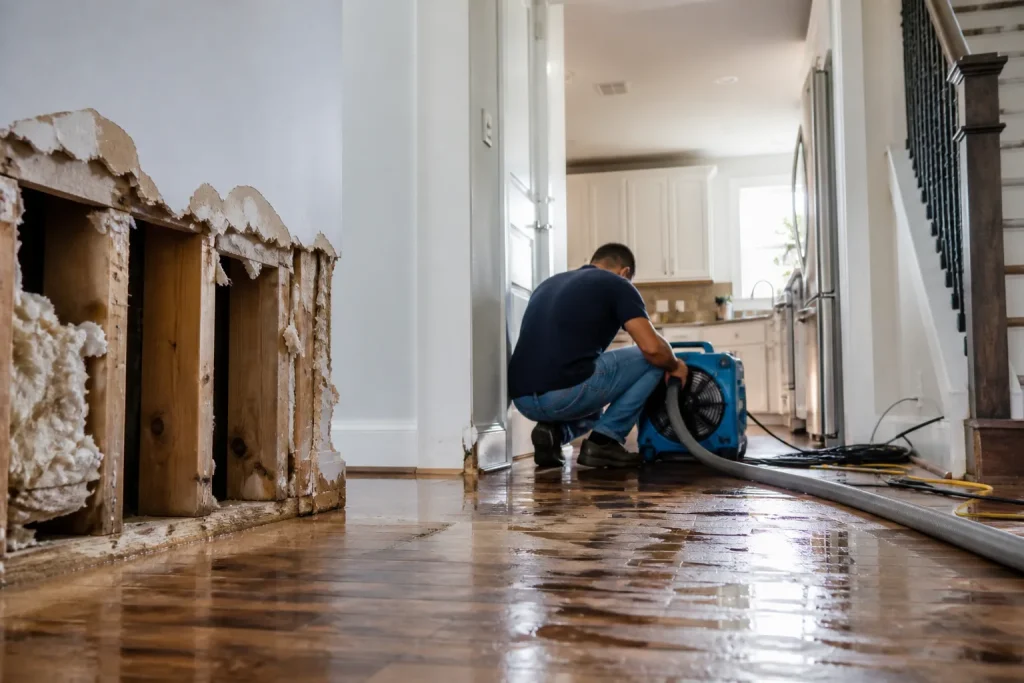
A correctly configured drying system in a standard Ontario residential space looks like this: air movers positioned to create a vortex of airflow across every wet surface, not just pointed at the visible puddle. LGR dehumidifiers sized to the cubic footage of the affected area and the class of water damage, not just what fits in the truck. Injection or panel drying systems on any wet wall cavity or under-floor space. And moisture sensors being used at the time of placement to map the actual boundary of the water migration, which is almost always larger than the visible stain.
We pulled a job in an Ontario neighborhood where a fridge supply line had been leaking behind the kitchen cabinets for three days before anyone noticed. The visible damage was a warped toe-kick. The moisture meter told a different story: water had migrated under the slab into an adjacent hallway and up the shared wall between the kitchen and the garage. If we’d set equipment based on the visible stain, that wall would have moldered inside for weeks. The first 24 hours of equipment placement either finds that hidden migration or it doesn’t.
Documentation: What Your Insurer Will Review and What Most Companies Don’t Do
Your insurance adjuster’s job is to authorize payment for work that was necessary, properly performed, and complete. The quality of your restoration company’s documentation determines whether that review is smooth or adversarial. Here’s what daily documentation should include:
- Psychrometric readings – temperature, relative humidity, and specific humidity of the affected area, logged daily
- Moisture content readings – percentage of moisture in specific materials, compared to a dry baseline from an unaffected room
- Equipment inventory logs – what was placed where, when, and what adjustments were made as readings changed
- Photo documentation – before, during, and after images of every affected area, including moisture meter readings visible in frame
- Drying chart – the graph showing the drying curve toward an established drying goal
Most Ontario restoration companies do the work and keep rough notes. When the adjuster asks for proof that drying was complete, the file is thin. We build the documentation file from the first assessment because we know it’s not just about drying the house; it’s about closing the claim. We’re affiliated with the RIA (Restoration Industry Association) and IFA, which keeps us accountable to professional standards beyond our own internal practices. That accountability matters when the insurance company starts asking questions.
When to call a pro: if water has touched drywall, baseboards, sub-flooring, or wall cavities, and you’re not running commercial-grade moisture meters and LGR dehumidifiers within 24 hours, you’re in over your head. Call (833) 589-8366 and get a real assessment.
Related services in Ontario: if you’re dealing with water damage, our Water Damage Restoration in Muscoy page covers the full process. If water has sat long enough to raise concerns about mold, see our Mold Remediation in Muscoy page. And if a water loss is paired with fire or smoke, we handle that too: Fire Damage Restoration in Muscoy.
The Bottom Line
Phoenix Water Damage Restoration is one name in the Ontario market, but when you’re standing in water at 11 p.m., the name on the invoice matters far less than the LGR dehumidifier capacity, the technician’s WRT and ASD certifications, and whether the company documents daily moisture readings your insurer will accept. Two Ontario restoration companies can look identical from the outside and produce wildly different outcomes based on equipment class and methodology alone.
If you’re in Ontario and need help, Dorchester Water Damage offers free estimates and runs professional-grade Dri-Eaz and Phoenix equipment with IICRC-aligned documentation from the first assessment. Call (833) 589-8366.
Frequently Asked Questions
Phoenix Water Damage Restoration operates in the Ontario market, but company names and local listings don’t tell you anything about equipment inventories, IICRC certification status, or drying methodology. Those are the variables that determine whether your home dries properly. Verify credentials on the IICRC registry and ask about LGR dehumidifier capacity before signing any authorization.
Water damage restoration in Ontario typically ranges from $2,000 for a contained Category 1 loss in a single room to $15,000 or more when Category 3 water affects multiple rooms and requires demolition. The final number depends on affected square footage, water category, and whether structural drying equipment like Injectidry systems can save materials from demolition. Call (833) 589-8366 for a free estimate based on a real assessment, not a phone guess.
Most established Ontario restoration companies respond within 60 to 90 minutes for water damage emergencies. The more important question is what they bring with them: a moisture meter, an LGR dehumidifier, and a written scope, or a mop and a fan. Speed matters only if the first equipment placement is done correctly.
Most Ontario homeowner policies cover sudden and accidental water damage from supply line failures, appliance leaks, and storm events. Gradual damage from long-term leaks is typically denied. Your restoration company’s documentation, including daily moisture logs and photo evidence, is what supports your claim. Choose a company whose paperwork holds up to adjuster review.
Written by the team at Dorchester Water Damage, serving Ontario since 2018.
Need Damage Restoration Help?
Call Dorchester Water Damage — licensed & insured, here with fast after-hours help in Ontario.
(833) 589-8366